
Night Driving Tips for New Ontario Drivers — 2026 Guide
Essential night driving tips for new Ontario drivers in 2026. Headlight rules, reduced visibility, wildlife hazards, fatigue, G1 restrictions, and how to build confidence after dark.
Night Driving Tips for New Ontario Drivers
Night driving is statistically more dangerous than daytime driving — not because roads change, but because you do. Your vision is reduced, your depth perception is less accurate, and your reaction time is slower when you are tired. Yet for most new Ontario drivers, night driving is an unavoidable reality from the day they get their G2 licence. This guide covers the practical skills, legal requirements, and safety habits that will help you drive confidently and safely after dark. For a complete overview of Ontario driving rules, see our G1 Study Guide.
Updated October 2026 · Ontario-specific · G1 and G2 drivers
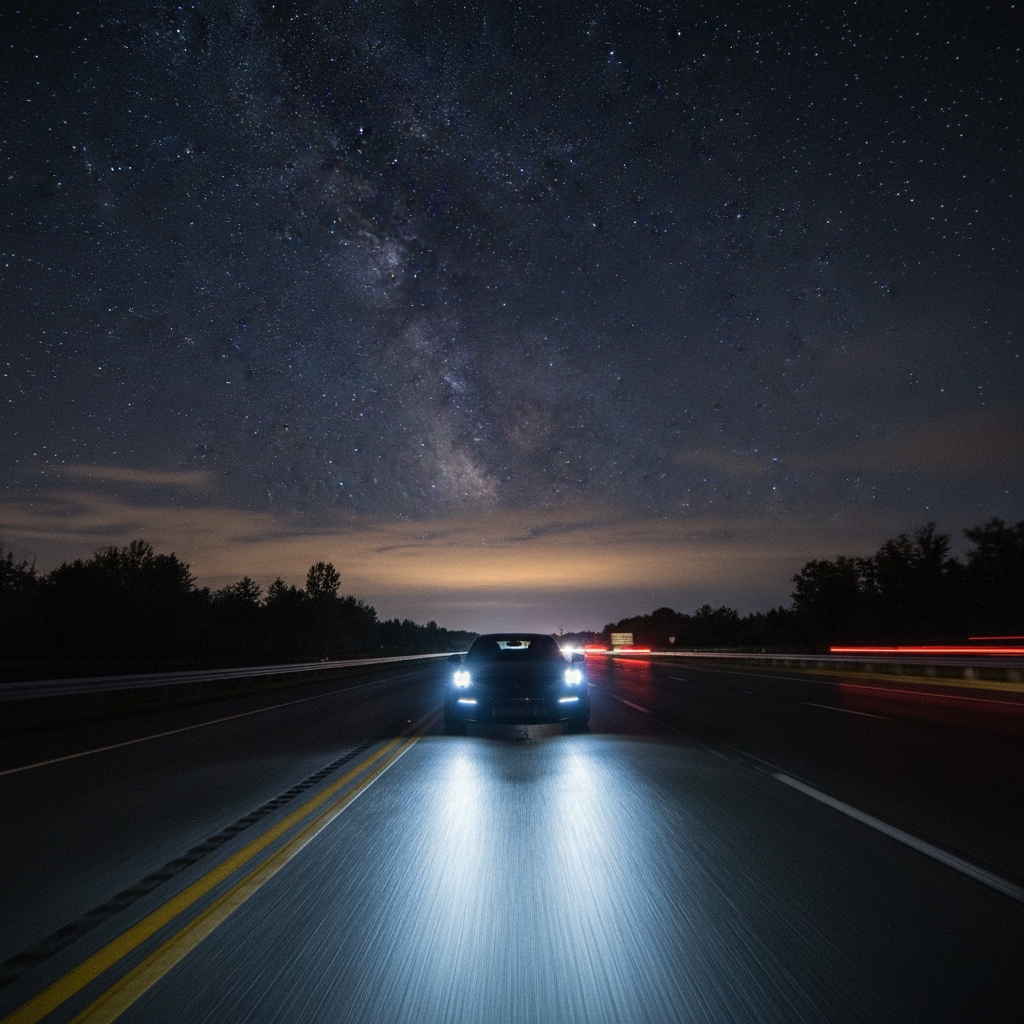
G1 Night Driving Restrictions
G1 licence holders in Ontario are prohibited from driving between midnight and 5 a.m. This is a hard restriction — not a guideline. Driving during these hours as a G1 driver is a violation of your licence conditions and can result in a fine and demerit points.
G2 drivers who received their licence after January 1, 2017 have no nighttime restriction — they can drive at any hour. However, G2 drivers who received their licence before that date may have a midnight curfew as a condition of their licence. Check the conditions printed on your licence card.
Even if you are legally permitted to drive at night, the absence of a restriction does not mean night driving is without risk. New drivers should build their night driving skills gradually — starting with familiar, well-lit routes before progressing to rural roads and highways after dark.
Ontario Headlight Laws at Night
Ontario law requires headlights to be on from 30 minutes after sunset to 30 minutes before sunrise. In practice, turn your headlights on when it starts to get dark — do not wait for full darkness. Many modern vehicles have automatic headlights, but confirm yours are working correctly.
Headlights are also required in any condition of poor visibility — fog, heavy rain, or snow — regardless of the time of day. The law is about visibility, not just darkness.
High beam rules — know these for the G1 test:
- • Use high beams on unlit roads when no vehicle is within 150 m ahead or approaching
- • Switch to low beams within 150 m of an oncoming vehicle
- • Switch to low beams when following another vehicle — regardless of distance
- • High beams in urban areas are generally unnecessary and can blind other drivers
| Situation | Required Lights |
|---|---|
| Night driving (30 min after sunset to 30 min before sunrise) | Headlights (low beam) + tail lights |
| Reduced visibility (fog, heavy rain, snow) | Headlights (low beam) + tail lights. Fog lights if equipped. |
| Wipers in use (any time) | Headlights required by law |
| Oncoming vehicle within 150 metres | Switch to low beams |
| Following another vehicle within 150 metres | Low beams only |
| Unlit rural road, no vehicles nearby | High beams permitted and recommended |
Overdriving Your Headlights — What It Means
"Overdriving your headlights" means driving at a speed where your stopping distance exceeds the distance illuminated by your headlights. In other words, if something appears at the edge of your headlight range, you will not be able to stop in time.
Low beam range
Low beams illuminate approximately 60 metres ahead of your vehicle.
Stopping distance at 100 km/h
At 100 km/h on a dry road, your total stopping distance (reaction + braking) is approximately 100 metres. On a wet road, this increases to 130–150 metres.
The problem
At 100 km/h, your stopping distance (100 m) is nearly double your low-beam visibility (60 m). You are overdriving your headlights — you cannot stop in time for a hazard you can just see.
The solution
Reduce your speed on unlit roads at night. A speed of 60–70 km/h brings your stopping distance within your headlight range. Use high beams where safe to extend your visibility.
Adjusting Your Driving for Night Conditions
Reduce Your Speed
At night, your headlights illuminate roughly 60–90 metres ahead on low beam. At 100 km/h, you cover 60 metres in just over 2 seconds — barely enough time to react to a hazard at the edge of your headlight range. This is called "overdriving your headlights." The safe rule: drive at a speed where you can stop within the distance your headlights illuminate.
Increase Following Distance
At night, increase your following distance to at least 4 seconds. This gives you more time to react to brake lights ahead and reduces the risk of being blinded by the vehicle ahead's brake lights reflecting off wet pavement.
Keep Your Windshield Clean
A dirty windshield that is barely noticeable during the day becomes a serious visibility problem at night. Oncoming headlights scatter off the film on the glass, creating glare that can temporarily blind you. Clean your windshield inside and out before night driving. Keep your washer fluid topped up.
Avoid Looking Directly at Oncoming Headlights
When an oncoming vehicle has its high beams on, do not stare at the headlights. Look toward the right edge of the road — the white line or the shoulder — and use it as a guide. Your peripheral vision will keep you aware of the road ahead while your central vision recovers from the glare.
Wildlife on Ontario Roads at Night
Ontario has one of the highest deer populations in Canada, and deer-vehicle collisions are most common between dusk and dawn — particularly in October and November during the rut. Deer are most active at these times, and a single deer on the road almost always means more are nearby.
Wildlife hazards are not limited to deer. Moose, raccoons, skunks, foxes, and coyotes are all active at night and can appear on roads with little warning. A moose collision at highway speed is frequently fatal — moose are tall enough that the body comes through the windshield rather than going over the hood.
Watch for eye shine
Animal eyes reflect headlights. If you see two small points of light at road level, slow down immediately — it is likely an animal.
If you see one deer, expect more
Deer travel in groups. If one crosses the road, stop and wait before proceeding — others are likely to follow.
If collision is unavoidable: brake firmly, do not swerve
Swerving for a deer can cause a rollover or head-on collision. Brake as hard as possible and hold your lane. The vehicle damage from hitting a deer is far less serious than a rollover or collision with oncoming traffic.
Report wildlife collisions to police
In Ontario, you are required to report a collision with wildlife if the animal is injured or dead on the road. Call the OPP non-emergency line or your local police.
Slow down in wildlife corridors
Areas near rivers, forests, and agricultural land are high-risk zones. Watch for wildlife warning signs and reduce speed, especially between dusk and dawn.
Fatigue — The Hidden Night Driving Danger
Fatigue is a factor in approximately 20% of fatal crashes in Ontario. The risk is highest between midnight and 6 a.m. — the same hours when G1 drivers are prohibited from driving. Fatigue impairs reaction time, judgement, and attention in ways that are similar to alcohol impairment, but without the obvious warning signs.
Warning signs of fatigue while driving: difficulty keeping your eyes open, drifting out of your lane, missing exits or turns, not remembering the last few kilometres, and yawning repeatedly. If you experience any of these, pull over safely and rest. Turning up the radio, opening the window, or drinking coffee are not effective solutions — they mask the symptoms without addressing the underlying fatigue.
For new drivers, the practical advice is simple: do not drive when you are tired. If you are going out late, plan your transportation in advance. If you are driving home after a long day and feel fatigued, pull into a well-lit parking lot and rest for 20 minutes before continuing.
Building Night Driving Confidence — A Practical Progression
Night driving confidence comes from deliberate practice, not from avoiding it. Here is a suggested progression for new G2 drivers:
Familiar neighbourhood at dusk
Start in an area you know well, just after sunset. Get comfortable with your headlights, mirrors, and reduced visibility.
Well-lit arterial roads at night
Progress to roads like Yonge Street, Hurontario, or Sheppard — well-lit, familiar, moderate traffic.
Suburban roads after 10 p.m.
Less traffic, darker conditions. Practice scanning for pedestrians, cyclists, and animals.
Highway driving at night
Once comfortable on surface roads, try a short highway trip at night. The 407 or Highway 400 north of Barrie are good starting points.
Rural roads at night
The most challenging night driving. No street lights, wildlife hazards, and narrow roads. Build up to this gradually.
Frequently Asked Questions
Can G1 drivers drive at night in Ontario?
No. G1 licence holders are prohibited from driving between midnight and 5 a.m. This restriction applies regardless of who is accompanying them. G2 drivers who received their licence before January 1, 2017 may also have a midnight curfew — check your licence conditions. G2 drivers who received their licence after that date can drive at any hour.
When should I use high beams?
Use high beams on unlit rural roads when no other vehicles are within 150 metres ahead of you or approaching from the opposite direction. Switch to low beams when you see oncoming headlights or when you are following another vehicle. High beams in the city are generally not needed and can blind other drivers.
What should I do if an oncoming driver does not dim their high beams?
Do not flash your high beams in retaliation — this creates a mutual blinding situation. Instead, slow down, look toward the right edge of the road (the white line or shoulder), and use it as a guide until the vehicle passes. Avoid looking directly at the oncoming headlights.
Is night driving tested on the G road test?
The G road test is not specifically conducted at night, but the examiner may test your knowledge of night driving rules. More importantly, night driving is a real-world skill you will need immediately after getting your G licence. Building confidence at night before your test is strongly recommended.
How do I deal with deer and wildlife on Ontario roads at night?
Deer are most active at dawn and dusk, and throughout the night. If you see one deer, assume there are more nearby. Slow down, activate your hazard lights briefly to warn following drivers, and scan the sides of the road. If a collision is unavoidable, brake firmly and do not swerve — swerving can cause a more serious crash.
Why do my eyes take time to adjust after oncoming headlights?
Your eyes use two types of photoreceptors: cones (for colour and detail in bright light) and rods (for low-light vision). When bright headlights hit your eyes, the rods are temporarily overwhelmed — a process called flash blindness. Recovery takes 5–10 seconds. During this time, slow down and use the road edge as a guide.
What is the speed limit at night on Ontario highways?
The posted speed limit applies at all times — there is no separate night speed limit in Ontario. However, the Highway Traffic Act requires you to drive at a speed that is safe for conditions. At night, reduced visibility means the safe speed is often lower than the posted limit, particularly on unlit rural roads.
Conclusion
Night driving in Ontario demands more from you as a driver — more attention, more caution, and a deeper understanding of your vehicle's limitations. The headlight rules are clear: on from 30 minutes after sunset, high beams only when no vehicle is within 150 m, and low beams when following or meeting traffic. Understanding that you are likely overdriving your headlights at highway speed on an unlit road is one of the most important insights a new driver can have.
Wildlife, fatigue, and reduced visibility are the three biggest night driving hazards in Ontario. Respect all three, build your skills gradually, and never drive when you are tired.
For more Ontario driving rules, visit our G1 Study Guide or review the Ontario Demerit Points Guide to understand the consequences of unsafe driving at night.
Related Guides
Last updated: October 2026 — reflects current Ontario Highway Traffic Act headlight requirements and G1/G2 licence conditions.
Ready to go deeper? Practice 300 G1 questions over 3 days.
Find your weak areas, review mistakes, and build real confidence before test day.