
Driving in Heavy Rain in Ontario — What You Need to Know
Ontario summers bring some of the most intense rainfall in Canada — sudden thunderstorms that can drop 50 mm of rain in under an hour, turning familiar roads into rivers and reducing visibility to near zero. Every year, wet-road collisions account for a significant portion of Ontario's serious traffic injuries. The good news is that most rain-related crashes are preventable. This guide covers everything you need to know to drive safely in heavy rain — from the moment the first drops hit your windshield to navigating a flooded intersection. For a full overview of Ontario driving rules, see our G1 Study Guide.
Updated October 2026 · Ontario-specific · All licence levels
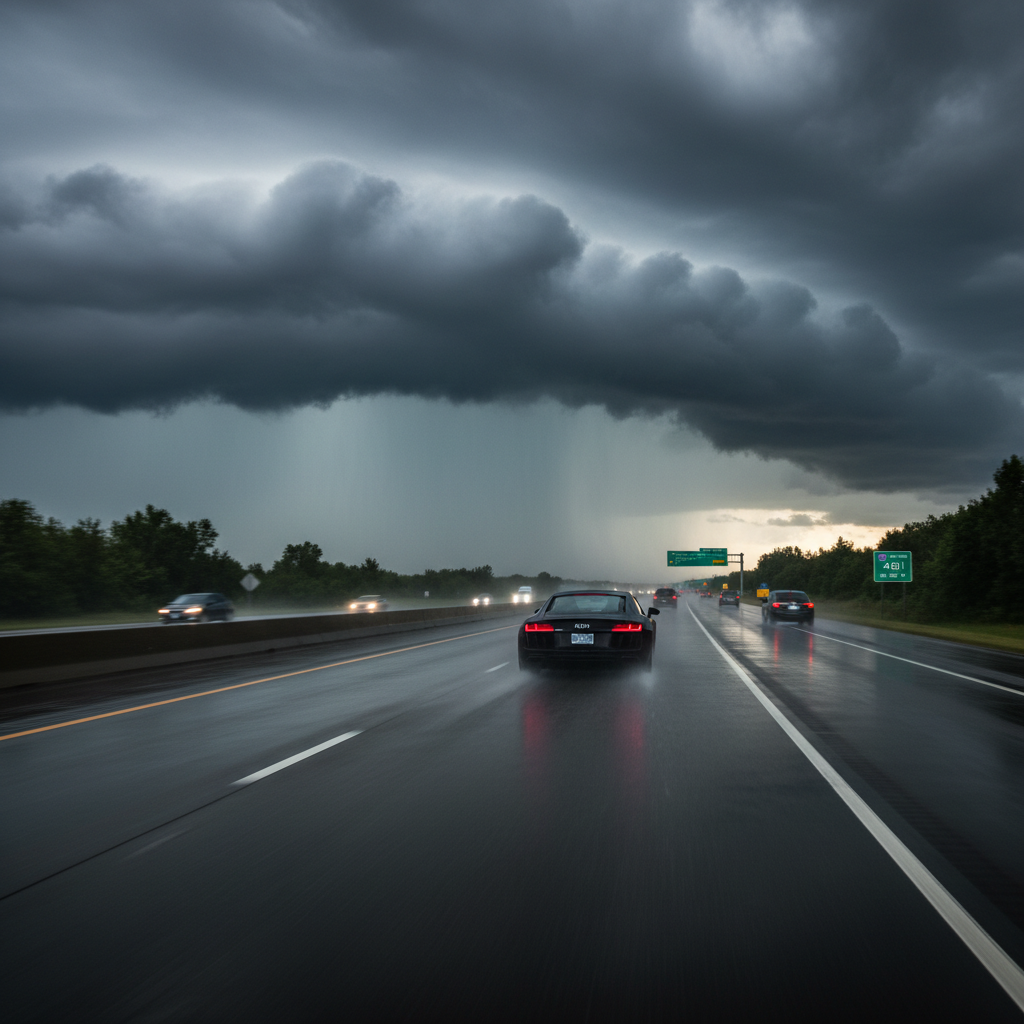
Ontario law: Headlights must be on whenever windshield wipers are in use. Daytime running lights do not satisfy this requirement. Failure to comply is a $110 fine.
Before You Drive: Preparation Matters
The best time to prepare for driving in rain is before the rain starts. A vehicle that is poorly maintained becomes genuinely dangerous in wet conditions. Before driving in heavy rain, check:
Windshield wipers
Wiper blades should clear the windshield cleanly in a single pass. Streaking or skipping means the blades are worn. Replace them — they are inexpensive and critical. Ontario winters are hard on wiper blades; inspect them every spring.
Tire tread depth
Tires need adequate tread to channel water away from the contact patch. The legal minimum in Ontario is 1.6 mm, but tires begin to lose wet-weather grip significantly below 3 mm. Use the toonie test: insert a toonie into the tread groove. If you can see the silver band above the bear's paws, your tread is below 4 mm — consider replacement.
Tire pressure
Under-inflated tires have a larger contact patch but less ability to channel water, increasing hydroplaning risk. Check pressure monthly and before long trips.
Headlights and tail lights
Confirm all lights are working. In heavy rain, your tail lights are as important as your headlights — they tell the driver behind you where you are.
Defroster
Rain causes windshields to fog from the inside. Confirm your front and rear defrosters work before you need them.
Adjusting Your Speed in Rain
The posted speed limit is the maximum speed for ideal conditions — dry road, good visibility, normal traffic. In heavy rain, the safe speed is almost always lower. Here is a practical guide:
| Condition | Suggested Reduction | Example (100 km/h zone) |
|---|---|---|
| Light rain, good visibility | 0–10 km/h | 90–100 km/h |
| Moderate rain, reduced visibility | 10–20 km/h | 80–90 km/h |
| Heavy rain, significantly reduced visibility | 20–40 km/h | 60–80 km/h |
| Severe storm, near-zero visibility | Pull over safely | Do not drive |
Remember: driving too slowly can also be dangerous. If you are travelling significantly below the flow of traffic, you create a hazard for drivers behind you. The goal is to drive at a speed that is safe for conditions while remaining predictable to other drivers.
Hydroplaning — What It Is and How to Prevent It
Hydroplaning is one of the most frightening experiences a driver can have — and one of the most misunderstood. It occurs when your tires encounter more water than they can channel away, causing them to ride on a thin film of water rather than gripping the road. At that moment, you have no steering control and no braking control.
Hydroplaning can occur at speeds as low as 80 km/h on a wet highway — and the risk increases significantly above that speed. Worn tires dramatically increase the risk because they have less tread depth to channel water away from the contact patch. The conditions that increase hydroplaning risk are: high speed, worn tires, heavy rainfall, standing water on the road, and shallow road drainage.
Prevention tips: Slow down on wet roads — especially above 80 km/h. Maintain proper tire pressure (check monthly). Replace tires before tread drops below 3 mm. Avoid sudden steering inputs on wet surfaces. Drive in the tracks of the vehicle ahead where water has been displaced.
How to Recover from Hydroplaning
Do not brake hard
Hard braking on a hydroplaning vehicle will not slow you down — your tires are not in contact with the road. Hard braking can cause the vehicle to spin.
Ease off the accelerator
Gently lift your foot from the gas pedal. This reduces speed gradually and allows the tires to begin channelling water again.
Hold the steering wheel straight
Do not make sudden steering inputs. Keep the wheel pointed in the direction you want to go.
Allow the vehicle to slow naturally
As speed decreases, the tires will regain contact with the road. You will feel the steering become responsive again.
Brake gently once control is restored
Once you feel the tires gripping again, you can apply gentle braking to slow further if needed.
Ontario Law: Headlights in Rain
Ontario's Highway Traffic Act (HTA) requires drivers to turn on their headlights whenever their windshield wipers are in use — even in light drizzle. This is not optional and applies at any time of day.
DRLs do NOT count
Daytime running lights (DRLs) illuminate the front of your vehicle but do not activate your tail lights. In rain, other drivers need to see your tail lights. DRLs do not satisfy the HTA headlight requirement.
Full headlights required
You must turn on your full headlight system — this activates both your headlights and your tail lights, making you visible from all directions.
Fine for non-compliance
Failure to use headlights when wipers are in use is a $110 fine under the HTA. It is also a mark against you on the G1 and G2 road tests.
Tested on the G1 knowledge test
This rule is a standard G1 test question. The correct answer is always: headlights ON whenever wipers are ON. Study more rules in our G1 Guide.
Flooded Roads — Turn Around, Don't Drown
Flash flooding is increasingly common in Ontario, particularly in the GTA. During intense summer storms, underpasses, low-lying roads, and areas near rivers and creeks can flood rapidly. The rule is simple: if you cannot see the road surface through the water, do not enter.
The phrase "Turn Around, Don't Drown" exists for a reason — moving water is far more powerful than it appears. Most flood-related vehicle deaths occur when drivers attempt to cross water they believe is shallow enough to pass through safely.
Common flood-prone locations in the GTA include: the underpass at Finch Avenue and the 400, the low section of Lakeshore Boulevard near Humber Bay, and various underpasses along the 401 corridor. Know the flood-prone spots on your regular routes and have alternate routes planned.
Visibility in Heavy Rain
In a severe Ontario thunderstorm, visibility can drop to less than 50 metres in seconds. At 100 km/h, you cover 50 metres in less than 2 seconds — meaning you have almost no time to react to a hazard you cannot see. When visibility drops to this level, the only safe option is to pull off the road.
How to Pull Over Safely in a Storm
- Signal and move to the right lane as soon as possible.
- Pull completely off the road — onto a parking lot, a side street, or a highway shoulder.
- Turn off your headlights. This prevents other drivers from following your lights off the road thinking you are still moving.
- Keep your hazard lights on so other drivers can see you are stopped.
- Wait until the worst of the storm passes before continuing.
Do not stop under an overpass. This is a common instinct but it is dangerous — it narrows the road and creates a hazard for other drivers who may also be trying to pull over.
Frequently Asked Questions
Do I have to turn my headlights on in the rain in Ontario?
Yes. Ontario law requires headlights to be on whenever windshield wipers are in use. This applies to light rain as well as heavy rain. Daytime running lights (DRLs) do not satisfy this requirement — you must turn on your full headlights, which also activates your tail lights.
What is hydroplaning and how do I recover from it?
Hydroplaning occurs when your tires ride on a layer of water rather than gripping the road surface. You lose steering and braking control. To recover: ease off the accelerator gently — do not brake hard. Hold the steering wheel straight. Allow the vehicle to slow naturally until the tires regain contact with the road. Avoid sudden steering inputs.
Is it safe to drive through a flooded road?
No. Never drive through standing water of unknown depth. As little as 15 cm of moving water can knock a person off their feet; 30 cm can float a small car. If you cannot see the road surface through the water, do not enter. Turn around and find an alternate route.
How much following distance should I leave in heavy rain?
At least double your normal following distance — a minimum of 6 seconds at highway speeds. Wet roads significantly increase stopping distances. At 100 km/h on a wet highway, your stopping distance can be 50–80% longer than on a dry road.
Should I use hazard lights in heavy rain?
No. Using hazard lights while driving in rain is illegal in Ontario and dangerous. Hazard lights signal that your vehicle is stopped or disabled. Using them while moving confuses other drivers and prevents them from reading your turn signals. If visibility is so poor that you feel you need hazard lights, pull over safely and wait for conditions to improve.
What should I do if my car starts to skid on a wet road?
For a front-wheel skid (understeer): ease off the accelerator and allow the front wheels to regain grip. Do not brake hard. For a rear-wheel skid (oversteer): steer gently in the direction of the skid (counter-steer) and ease off the accelerator. Avoid sudden braking. Modern vehicles with electronic stability control (ESC) will assist, but you must still respond correctly.
Can I get a ticket for driving too fast in the rain?
Yes. Even if you are driving at or below the posted speed limit, you can be charged with careless driving if your speed is inappropriate for the conditions. In heavy rain, the safe speed may be well below the posted limit. Careless driving carries 6 demerit points and a fine of up to $2,000.
Conclusion
Driving in heavy rain in Ontario is a skill that every driver needs — and one that is tested both on the G1 knowledge test and in real life from the moment you get your licence. The core principles are straightforward: slow down, turn on your headlights, increase your following distance, and never drive through flooded roads of unknown depth.
Understanding hydroplaning and knowing how to recover from it could save your life. Knowing that Ontario law requires headlights whenever wipers are in use — and that DRLs don't count — could save you a fine and demerit points. And remembering "Turn Around, Don't Drown" could save you from a far more serious situation.
For more Ontario driving rules and test preparation, visit our G1 Study Guide or review the Ontario Demerit Points Guide to understand the consequences of unsafe driving in all conditions.
Related Guides
Ready to go deeper? Practice 300 G1 questions over 3 days.
Find your weak areas, review mistakes, and build real confidence before test day.
Last updated: October 2026 — reflects current Ontario Highway Traffic Act requirements and Transport Canada wet-weather driving guidelines.