
Ontario Speed Limits Guide 2026 — Complete Reference
Maximum speed limit in Ontario is 100 km/h on 400-series highways, 50 km/h on urban streets, and 40 km/h in school zones. Complete 2026 guide with demerit points and G1 test tips.
Ontario Speed Limits 2026 — Complete G1 Study Guide
Speed limit questions appear on every Ontario G1 knowledge test. Knowing the default limits, school zone rules, highway speeds, and stunt driving thresholds is essential to passing your G1 — and to driving safely for life. This guide covers everything you need to know.
Based on the Ontario Driver's Handbook and Highway Traffic Act. Updated October 2026. All speed limits reflect current Ontario law.
Ontario Speed Limits at a Glance
These are the speed limits you must know for the G1 knowledge test. Memorize the defaults — they apply whenever no sign is posted.
| Zone / Road Type | Speed Limit | Notes |
|---|---|---|
| Urban/residential streets | 50 km/h | Default — unless posted otherwise |
| School zones | 40 km/h | During school hours; some municipalities 30 km/h |
| Playground zones | 15 km/h | When children are present |
| Community safety zones | Varies | Posted; fines doubled |
| Rural roads (outside urban) | 80 km/h | Default — unless posted otherwise |
| 400-series highways | 100 km/h | Posted; some sections 90 km/h |
| Construction zones | Posted (reduced) | Fines doubled when workers present |
| Hospital zones | Posted (reduced) | Watch for signs near hospitals |
Understanding Default Speed Limits
Ontario has two default speed limits that apply when no sign is posted. These are tested directly on the G1 knowledge test — you must know both.
The default speed limit on any road within a city, town, or village in Ontario — unless a sign says otherwise. This includes residential streets, downtown roads, and local roads.
The default speed limit on roads outside cities and towns — unless a sign says otherwise. Applies to county roads, rural highways, and secondary roads not otherwise posted.
G1 test tip: Questions often ask "what is the speed limit if no sign is posted?" The answer depends on whether you're in an urban area (50 km/h) or a rural area (80 km/h). Read the question carefully.
Special Speed Zones You Must Know
School Zones
School zones have a reduced speed limit of 40 km/h during school hours. Some municipalities (including parts of Toronto) have reduced school zone limits to 30 km/h. Watch for posted signs — they override the default.
- School zone signs are typically yellow with a children crossing symbol
- The reduced limit applies during school hours — usually 8 a.m. to 5 p.m. on school days
- Some school zones have flashing lights to indicate when the reduced limit is active
- Fines for speeding in school zones are significantly higher than standard speeding fines
Playground Zones
Playground zones have a speed limit of 15 km/h when children are present. This is one of the lowest speed limits in Ontario — and it's frequently tested on the G1 exam.
Construction Zones
Construction zones are marked with orange signs and have reduced speed limits. Fines for speeding in construction zones are doubled when workers are present. Always slow down and watch for workers, equipment, and lane changes.
Community Safety Zones
Any municipality in Ontario can designate a road as a Community Safety Zone — and many do. These zones are commonly found near schools, hospitals, community centres, and parks. Watch for the distinctive orange signs.
Fines are doubled
All traffic fines — including speeding — are doubled in community safety zones. A fine that would normally be $150 becomes $300.
Speed limits are posted
The speed limit within a community safety zone is posted on signs. It may be the same as the surrounding road or reduced.
Applies to all violations
It is not just speeding — all traffic violations carry doubled fines in community safety zones, including failing to stop, improper turns, and more.
Watch for orange signs
Community safety zone signs are orange and rectangular. They mark the start and end of the zone.
Highway Speed Limits in Ontario
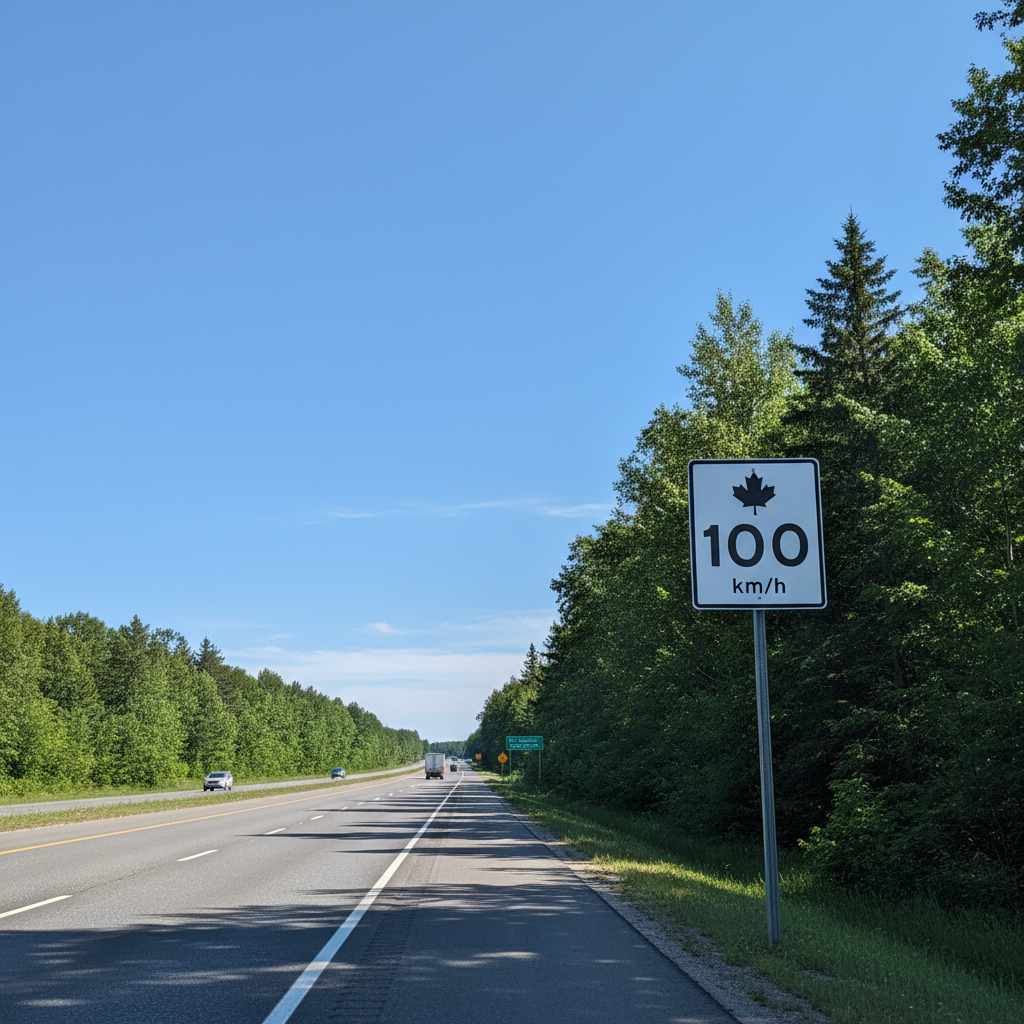
Ontario's 400-series highways (Highway 400, 401, 404, 407, 410, 427, QEW, etc.) have a posted speed limit of 100 km/h on most sections. Some sections near urban areas may be posted at 90 km/h.
- Always follow the posted speed limit — 100 km/h is the maximum, not the target
- In poor weather (rain, snow, fog), reduce your speed well below the posted limit
- The left lane on a highway is for passing only — move right after passing
- Minimum speed limits may be posted on some highways — driving too slowly is also dangerous
- G1 drivers cannot drive on 400-series highways (except with a driving instructor)
Speeding Penalties & Demerit Points
Speeding in Ontario carries both fines and demerit points. The more you exceed the limit, the more severe the penalty. These thresholds are tested on the G1 knowledge test. For a full breakdown, see the Ontario Demerit Points Guide.
1–15 km/h over
Fine only
16–29 km/h over
Fine + demerit points
30–49 km/h over
Fine + demerit points
50+ km/h over
Stunt driving — licence suspension, impound
Stunt Driving in Ontario — The 40 km/h Rule
Stunt driving is one of Ontario's most serious traffic offences — and one of the most important topics for the G1 test. The threshold is lower than most drivers expect.
Stunt driving thresholds in Ontario:
- •40 km/h or more over the limit on roads posted under 80 km/h
- •50 km/h or more over the limit on roads posted 80 km/h or higher
Stunt driving is treated as a serious criminal-level offence in Ontario. Penalties are immediate and severe:
- ✗Immediate roadside licence suspension (30 days for first offence)
- ✗Vehicle impounded for 14 days at the driver's expense
- ✗Fine of $2,000 to $10,000
- ✗6 demerit points upon conviction
- ✗Possible jail time (up to 6 months)
- ✗Licence suspension of 1–3 years on conviction
On a 50 km/h residential street, you can be charged with stunt driving at just 90 km/h. On a 100 km/h highway, the threshold is 150 km/h. These numbers are tested on the G1 knowledge test.
Speed Limits and the G1/G2 Road Test
Speed management is one of the most commonly failed areas on both the G2 and G road tests. Many new drivers assume that driving slowly is always safe — but examiners mark you for both speeding and driving too slowly.
Drive at the posted limit under normal conditions
On a clear, dry road with normal traffic, you should be driving at or near the posted speed limit. Driving more than 10 km/h under the limit without a reason is a mark against you.
Reduce speed appropriately for conditions
In school zones, construction zones, or poor weather, reduce your speed. Failing to slow down in these situations is also a mark against you.
Accelerate smoothly after stops
After a stop sign or red light, accelerate smoothly to the posted speed. Crawling away from a stop is marked as poor speed management.
Highway on-ramps
On the G road test, you must accelerate to highway speed on the on-ramp before merging. Merging at 60 km/h on a 100 km/h highway is a serious error.
For a full breakdown of what examiners look for, see the G2 Road Test Guide.
G1 Test Tips — Speed Limit Questions
Speed limit questions are among the most commonly tested topics on the Ontario G1 knowledge test. Here's how to approach them:
Memorize the two defaults
50 km/h in urban areas, 80 km/h on rural roads. These appear on almost every G1 test.
Know the special zones
School zones (40 km/h), playground zones (15 km/h), and construction zones (reduced + doubled fines) are frequently tested.
Know the stunt driving threshold
40 km/h over on lower-speed roads, 50 km/h over on 80+ km/h roads. This is a common G1 question.
Demerit point thresholds
16–29 km/h over = 3 points; 30–49 km/h over = 4 points; 50+ km/h over = 6 points + stunt driving.
Posted signs always override defaults
If a sign is posted, follow it — even if it's higher or lower than the default. The sign is the law.
Continue Studying for Your G1 Test
Free G1 Practice Test — 40 Questions
Full-length practice test with all topics
G1 Rules of the Road Quiz
Practice G1 rules questions
Ontario Demerit Points Guide
Full demerit points breakdown
Ontario Stunt Driving Rules
Stunt driving laws explained
G2 Road Test Guide
Everything you need to pass the G2 road test
G1 Study Guide
Everything you need to pass the G1 test
Frequently Asked Questions
What is the default speed limit in Ontario if no sign is posted?
In urban areas and residential streets, the default speed limit is 50 km/h. On highways outside urban areas, the default is 80 km/h. On 400-series highways, the posted limit is typically 100 km/h. Always follow posted signs — they override the default.
What is the speed limit in a school zone in Ontario?
School zones in Ontario have a reduced speed limit of 40 km/h when the school zone signs are in effect (typically during school hours). Some municipalities have reduced this further to 30 km/h. Watch for posted signs.
Can you drive faster than the posted speed limit to pass another vehicle?
No. You may never exceed the posted speed limit to pass another vehicle in Ontario. Passing must be done safely within the legal speed limit. Exceeding the limit while passing is still a speeding offence.
What is stunt driving in Ontario and how does it relate to speed?
Stunt driving includes driving 40 km/h or more over the speed limit (50 km/h over on roads posted 80 km/h or higher). Penalties include immediate roadside licence suspension, vehicle impoundment, and fines of $2,000–$10,000.
Are speed limits different in construction zones?
Yes. Construction zones have reduced speed limits posted on orange signs. Fines for speeding in construction zones are doubled when workers are present. Always slow down and watch for workers and equipment.
What speed limit applies on 400-series highways in Ontario?
Most 400-series highways (Highway 400, 401, 404, 407, 410, 427, etc.) have a posted speed limit of 100 km/h. Some sections near urban areas may be posted at 90 km/h. Always follow the posted signs.
Conclusion
Ontario's speed limit system is more nuanced than a single number. The two default limits (50 km/h urban, 80 km/h rural) form the foundation, but school zones, playground zones, community safety zones, construction zones, and stunt driving thresholds all add layers that every driver — and every G1 test candidate — must understand.
The consequences of getting it wrong escalate quickly: from a small fine for 1–15 km/h over, to a $10,000 fine, vehicle impoundment, and immediate licence suspension for stunt driving. Knowing where the lines are drawn is not just about passing the G1 test — it is about protecting yourself and everyone else on Ontario roads.
Ready to test your knowledge? Try our Free G1 Practice Test, review the Ontario Demerit Points Guide, or check the G2 Road Test Guide to see how speed management is evaluated on the road test.
Ready to Test Your Knowledge?
Speed limits are just one topic on the G1 test. Practice all 100 questions to make sure you're fully prepared.
Ready to go deeper? Practice 300 G1 questions over 3 days.
Find your weak areas, review mistakes, and build real confidence before test day.