
Emergency Vehicle Rules Every Ontario Driver Should Know — 2026
Ontario emergency vehicle rules explained for 2026. What to do when lights and sirens approach, Move Over law, stopped emergency vehicles, school buses, and G1/G2 test tips.
Emergency Vehicle Rules Every Ontario Driver Should Know
Every year in Ontario, emergency responders are injured or killed by drivers who did not know — or did not follow — the rules for yielding to emergency vehicles. These rules are not complicated, but they require immediate, correct action in a high-stress moment. Whether you are a new G1 driver studying for your knowledge test or an experienced driver who wants a refresher, this guide covers everything you need to know about Ontario's emergency vehicle laws in 2026. For a full overview of Ontario driving rules, see our G1 Study Guide.
Updated October 2026 · Ontario Highway Traffic Act · G1 knowledge test topic
Critical: Failing to yield to an emergency vehicle in Ontario carries a fine of $400–$2,000 and 3 demerit points. In serious cases, criminal charges may apply.
Rule 1: Yield and Pull Over When an Emergency Vehicle Approaches
Under Section 159 of Ontario's Highway Traffic Act, when an emergency vehicle (police, fire, ambulance) is approaching with its lights and/or siren activated, every driver must:
Pull to the right side of the road
Move as far right as safely possible. If you are on a multi-lane road, move to the right lane first, then to the shoulder if there is one.
Come to a complete stop
Stop your vehicle and remain stopped until the emergency vehicle has passed and it is safe to proceed.
Do this regardless of which direction the emergency vehicle is travelling
Even if the emergency vehicle is in the opposite lane, you must pull over and stop. The only exception is a divided highway with a physical barrier — in that case, vehicles on the opposite side do not need to stop.
Do not block intersections
If you are approaching an intersection when an emergency vehicle activates its lights, do not stop in the intersection. Pull through the intersection first if it is safe, then pull over.
Move Over Law — Full Details
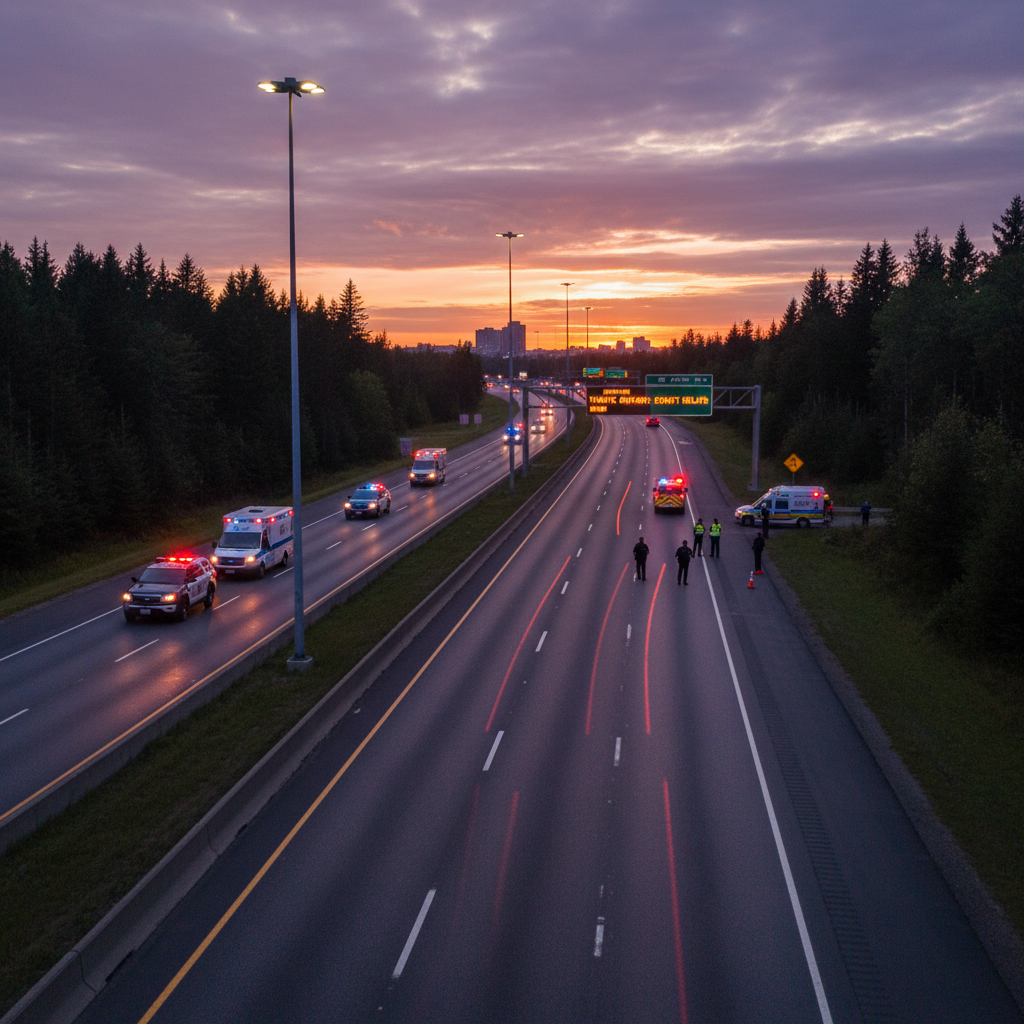
Ontario's Move Over law (Highway Traffic Act, Section 159) is one of the most important — and most violated — traffic laws in the province. It applies whenever you are approaching a stopped emergency vehicle, tow truck, or road maintenance vehicle that has its flashing lights activated on the side of the road.
Vehicles covered
Police vehicles, fire trucks, ambulances, tow trucks, and road maintenance vehicles (MTO and municipal). Any vehicle with flashing lights stopped on the roadside.
Move over one full lane
If you can safely move over, you must move one full lane away from the stopped vehicle before passing. On a two-lane road, this means moving to the far lane.
If you cannot move over
Slow to 60 km/h or less and pass with caution. This applies on single-lane roads and when moving over is not safe.
Applies on all roads including highways
The Move Over law applies on all Ontario roads — city streets, county roads, and 400-series highways alike.
Fine: $400–$2,000 + 3 demerit points
Failure to comply is a serious offence. Fines range from $400 to $2,000 plus 3 demerit points. Repeat offenders face higher penalties.
| Situation | Required Action |
|---|---|
| Multi-lane road — you can safely move over | Move one full lane away from the stopped vehicle before passing. |
| Multi-lane road — you cannot safely move over | Slow to 60 km/h or less and pass with caution. |
| Single-lane road — no room to move over | Slow to 60 km/h or less and pass with caution. |
| Highway — you can safely move over | Move one full lane away. If in the right lane, move to the centre lane. |
| Highway — you cannot safely move over | Slow to 60 km/h or less and pass with caution. |
Emergency Vehicles at Intersections
Intersections create a specific challenge when an emergency vehicle approaches. Many drivers make the mistake of stopping in the intersection — which actually blocks the emergency vehicle's path. Here is the correct procedure:
If you are already in the intersection
Complete your turn or proceed through the intersection safely. Do not stop in the middle of the intersection — this blocks the emergency vehicle and creates a hazard for cross traffic.
Once clear of the intersection
Pull to the right side of the road and come to a complete stop. Stay stopped until the emergency vehicle has passed.
If you have not yet entered the intersection
Stop before the intersection (at the stop line or crosswalk) and wait for the emergency vehicle to pass before proceeding.
Do not block the intersection
The intersection must remain clear so the emergency vehicle can pass through. Never stop your vehicle in a way that blocks the intersection.
Funeral Processions
Funeral processions have a special status on Ontario roads that is tested on the G1 knowledge test. A funeral procession is a group of vehicles travelling together to a burial site, typically led by a hearse and identified by headlights on and/or funeral flags.
Do not cut through a funeral procession
You must not drive through or cut into a funeral procession. All vehicles in the procession have the right to stay together, even through red lights (in some municipalities).
Yield to vehicles in the procession
If a funeral procession is moving through an intersection, yield to all vehicles in the procession even if you have a green light.
Tested on the G1 knowledge test
Funeral procession rules are a standard G1 test topic. The key rule is: do not cut through a procession and yield to procession vehicles.
What Counts as an Emergency Vehicle in Ontario?
Police vehicles
OPP, municipal police, RCMP. Yield when lights and/or siren are active.
Ambulances
Land ambulances operated by municipalities or private services.
Fire trucks
All fire department vehicles, including ladder trucks and rescue units.
Tow trucks
Covered under the Move Over law when stopped with flashing lights.
Road maintenance vehicles
MTO and municipal maintenance vehicles with flashing amber lights.
Coroner's vehicles
Designated coroner vehicles with lights activated.
Common Mistakes Drivers Make with Emergency Vehicles
✗ Stopping in the intersection instead of pulling through
If you are in or approaching an intersection when an emergency vehicle activates its lights, clear the intersection first, then pull over. Stopping in the intersection blocks the emergency vehicle.
✗ Following the emergency vehicle through a red light
The emergency vehicle has a legal exemption. You do not. Stop at the red light and wait for it to turn green.
✗ Pulling left instead of right
Always pull to the right. Pulling left can put you in the path of the emergency vehicle, which may be using the centre or left lane to pass stopped traffic.
✗ Not moving over for a stopped tow truck
Many drivers know to move over for police and ambulances but forget that the Move Over law also applies to tow trucks and road maintenance vehicles.
✗ Resuming speed immediately after the emergency vehicle passes
Wait until the emergency vehicle is well past and it is safe to merge back into traffic. Other emergency vehicles may be following.
Emergency Vehicle Rules on the G1 Knowledge Test
Emergency vehicle rules are a guaranteed topic on the Ontario G1 knowledge test. Based on past test questions, you should know:
- What to do when an emergency vehicle approaches with lights and siren
- The Move Over law — when it applies and what the required action is
- Whether you must pull over for an emergency vehicle in the opposite lane
- What to do at an intersection when an emergency vehicle approaches
- Whether you can follow an emergency vehicle through a red light
- The penalties for failing to yield to an emergency vehicle
- Funeral procession rules — do not cut through, yield to procession vehicles
Practice these scenarios with our G1 Emergency Vehicles Practice Test — a dedicated quiz covering all emergency vehicle scenarios from the Ontario Driver's Handbook.
Frequently Asked Questions
What is the Move Over law in Ontario?
Ontario's Move Over law (Highway Traffic Act, Section 159) requires drivers to slow down and move over one lane when passing a stopped emergency vehicle, tow truck, or road maintenance vehicle with flashing lights on the side of the road. If you cannot safely move over, you must slow to 60 km/h or less. Failure to comply carries a fine of $400–$2,000 and 3 demerit points.
Do I have to pull over for an ambulance even if I am in the opposite lane?
Yes. Ontario law requires all drivers to pull to the right and stop when an emergency vehicle with lights and sirens is approaching — regardless of which direction it is travelling. The only exception is if pulling over would create a greater hazard (e.g., you are on a bridge with no shoulder).
What happens if I do not yield to an emergency vehicle?
Failing to yield to an emergency vehicle is a serious offence under the Highway Traffic Act. It carries a fine of $400–$2,000, 3 demerit points, and a possible licence suspension. In cases where failure to yield contributes to a collision, criminal charges may also apply.
Can I follow an emergency vehicle through a red light?
No. Emergency vehicles are exempt from traffic signals when responding to a call. You are not. If an ambulance runs a red light, you must still stop at the red light. Following an emergency vehicle through a red light is illegal and dangerous — cross traffic may not see you.
Is this tested on the G1 knowledge test?
Yes. Emergency vehicle rules are a standard topic on the G1 knowledge test. Questions typically cover what to do when an emergency vehicle approaches, the Move Over law, and the rules for stopped emergency vehicles on the roadside.
What should I do if an emergency vehicle is behind me on a narrow road with no shoulder?
If there is no safe place to pull over, slow down and move as far right as possible. Activate your hazard lights to signal to the emergency vehicle that you are aware of them and trying to yield. Continue moving forward slowly until you reach a safe place to pull over completely.
Do the same rules apply to police vehicles that are not using lights and sirens?
No. The requirement to pull over and stop applies only when emergency vehicles are using their lights and sirens (or lights alone in some situations). A police vehicle travelling normally in traffic has no special right of way beyond normal traffic rules.
Conclusion
Ontario's emergency vehicle rules exist to protect the lives of first responders and road workers — people who are already in a dangerous situation when you encounter them. The rules are clear: pull right and stop when an emergency vehicle approaches with lights and sirens; move over one lane (or slow to 60 km/h) when passing a stopped emergency vehicle on the roadside; never stop in an intersection; never follow an emergency vehicle through a red light.
The Move Over law applies to police, fire, ambulance, tow trucks, and road maintenance vehicles on all Ontario roads. Funeral procession rules require you to yield and not cut through the procession. All of these rules are tested on the G1 knowledge test — and all of them matter in real life.
For more Ontario driving rules, visit our G1 Study Guide or review the Ontario Demerit Points Guide to understand the full consequences of traffic violations.
Related Guides
Last updated: October 2026 — reflects current Ontario Highway Traffic Act Section 159 (emergency vehicles) and Move Over law requirements.
Ready to go deeper? Practice 300 G1 questions over 3 days.
Find your weak areas, review mistakes, and build real confidence before test day.